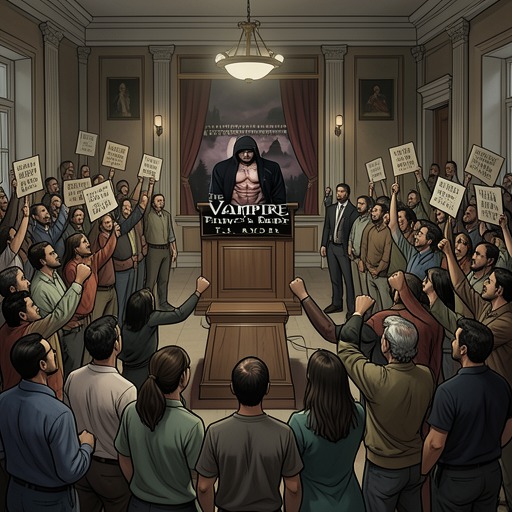
Shifter-Side Suppression
The Vampire Prince’s BrideShifter-Side Suppression names the forced denial, concealment, or attempted removal of a shifter’s animal identity. The novel distinguishes between choosing when to shift and choosing whether to possess a Beast at all: the former is voluntary, while the latter is tied to inheritance and cannot simply be willed away. Suppression therefore turns a natural part of shifter personhood into a forbidden secret, with consequences that reach from private mental illness to public law and political violence.
Definition and Social Origin
Shifter identity is presented as partly genetic. Children of shifters are more likely to be shifters, and a child with a predatory shifter parent tends toward predation, although the available research remains limited. That uncertainty leaves room for stereotypes, especially the false claim that shifters can decide whether they have an animal side. Anti-shifter hysteria groups exploit the distinction between voluntary shifting and involuntary identity, treating the ability to control transformation as evidence that the underlying nature can also be rejected.
From that false premise arise therapies devoted to suppressing the animal side. The novel portrays these practices as socially produced rather than medically neutral. They answer fear of shifters by demanding that shifters conceal or disown themselves, while the surrounding society remains free to define which forms of animality appear acceptable. The political contrast is visible in the reception of Senator Seth Fischer, whose golden-retriever form makes him easier for the public to accept than a tiger, deer, or fox might be. Respectability does not remove the prejudice; it merely demonstrates how strongly public sympathy depends on an animal stereotype.
Psychological Consequences
The Beast is not merely a metaphor or an external monster. A shifter can hear its voice, and outsiders may mistake that internal dialogue for schizophrenia. When a person suppresses the shifter side for too long, refuses to acknowledge the Beast, or stops communicating with it, the resulting strain can develop into mental illness. The novel thus treats the animal identity as part of a divided but necessary self, not as a contaminant that a healthy person should excise.
The irony is central to the concept. Shifters hide because they fear what others will say or do, and the prolonged denial can eventually produce the psychological collapse that anti-shifter groups cite as evidence of inherent danger. Suppression manufactures the appearance of instability and then uses that appearance to justify further suppression. The cycle is both personal and structural: fear creates secrecy, secrecy creates isolation, isolation creates breakdown, and breakdown is reclassified as proof that the feared group cannot be trusted.
Crystal Scott and the Warehouse Crisis
Crystal Scott embodies the most catastrophic form of this process. After being raised by anti-shifter parents and rejected by her husband when he learned that she was a shifter, she came to believe that her Beast was a demon inside her. During the warehouse confrontation, she insisted that shifters did not deserve to walk free and that the animal side had to be cut out before it could harm anyone. Her conviction was not presented as a calculated deception; she genuinely believed the ideology that had taught her to hate herself.
Joseph Baker identifies the cause while restraining her. He tells her that her suffering comes from suppressing the shifter side and from failing to communicate with her Beast. Crystal’s mental collapse is therefore connected directly to the violence surrounding her, rather than treated as an isolated defect. The warehouse floor, crowded with dead bodies, makes the political cost visible: hatred of shifters has produced both physical casualties and a living person who has been psychologically broken by the demand to deny her identity.
Ana Medina witnesses the scene and recognizes that advocacy can no longer remain abstract. Crystal’s condition makes the danger of concealment unmistakable to her, while Joseph understands that public disclosure of his own shifter identity must replace the guarded life he has maintained among coworkers. Their reaction transforms the concept from private tragedy into a demand for collective change.
Political Response and Reform
Senator Seth Fischer turns Crystal’s tragedy into the center of his public case against the Shifter Registry Act. He argues that laws which force shifters to hide or suppress themselves damage their mental health and make legal discrimination part of a country that claims to be free. His appeal asks who freedom is actually for and calls on shifters to declare their presence and refuse silence. The speech does not erase Crystal’s suffering; it changes the meaning assigned to it, preventing anti-shifter groups from using her as simple evidence for registration and detention.
Ana returns to work with Fischer and researches arguments against the proposed registry. She and Joseph recognize that the registry could become the first step toward a Shifter Detainment Act, so opposition to suppression must include opposition to the institutions that would formalize it. The novel links personal acceptance, scientific understanding, and civil rights: shifters need the freedom to acknowledge their Beasts, researchers need to reject damaging assumptions, and lawmakers need to end the legal conditions that reward concealment.
Ethical and Thematic Significance
The same moral conflict appears in another species context when Shay refuses to let researchers experiment on Gemma or her unborn child. The claim that fetal DNA would be more potent than adult DNA is answered by an ethics of consent: experimentation on beings unable to give reasonable understanding and consent is described as sacrilege against science itself. Although this debate concerns reproductive research rather than shifter identity, it reinforces the novel’s broader opposition to treating embodied difference as a resource to be extracted or a condition to be corrected.
The concept also gains force through contrasts with other forms of identity and care. Scarlett Brenan hears Maximillian Barnes describe the emotional burden of killing as a weight like a backpack of bricks, made bearable only by love; his confession frames acceptance as a relationship in which a person can be known rather than compartmentalized. By contrast, Mayumi May’s hostility toward her daughter Lola arises from an inherited witch lineage and from resentment over which generation receives magical ability. Both situations show identity becoming a source of family pressure when it is judged against a controlling norm, but Shifter-Side Suppression is distinguished by its explicit social consequences: the denial of the Beast can produce illness, persecution, and violence.
The novel’s central claim is therefore corrective rather than punitive. A shifter is not sick merely because a Beast exists, and voluntary transformation does not make the underlying identity optional. Suppression is the wound created when a community teaches people to experience an essential part of themselves as shameful. Its remedy is not forced exposure or another form of control, but recognition, communication, legal protection, and the right to live without being compelled to choose between public safety and personal wholeness.